
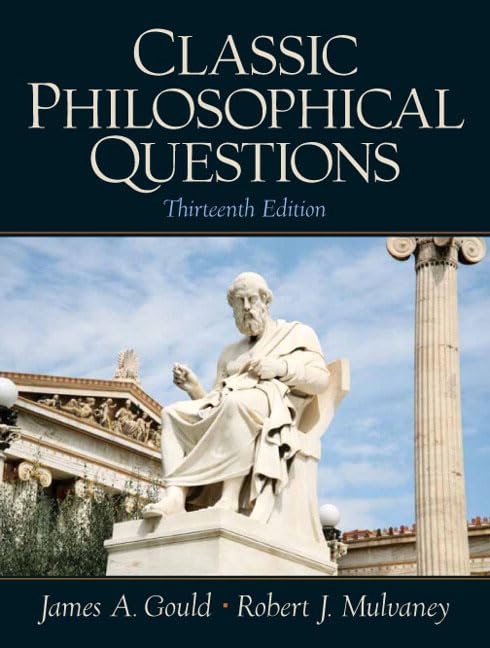
Classic philosophical questions / edited by Robert J. Mulvaney.
Material type: TextPublication details: Upper Saddle River, N.J. : Prentice Hall, 2009.Edition: 13th edDescription: xiv, 576 p. ; 23 cmISBN:
 - 9780136006527 (alk. paper)
- 0136006523 (alk. paper)
- 100 22
- BD21 .C594 2009
| Cover image | Item type | Current library | Home library | Collection | Shelving location | Call number | Materials specified | Vol info | URL | Copy number | Status | Notes | Date due | Barcode | Item holds | Item hold queue priority | Course reserves | |
|---|---|---|---|---|---|---|---|---|---|---|---|---|---|---|---|---|---|---|
 General Books
|
CUTN Central Library Reference | 100 (Browse shelf(Opens below)) | 1 | Available | 395 |
Browsing CUTN Central Library shelves,Shelving location: Reference Close shelf browser (Hides shelf browser)


Includes bibliographical references and index.
Plato and the trial of Socrates -- What is philosophy? -- Euthyphro : defining philosophical terms -- The apology, Phaedo, and Crito : the trial, immortality, and death of Socrates -- Philosophy of religion -- Can we prove that God exists? -- St. Anselm : the ontological argument -- St. Thomas Aquinas : the cosmological argument -- William Paley : the teleological argument -- Blaise Pascal : it is better to believe in God's existence than to deny it -- William James : free choice is the basis of belief -- Does the idea of a good God exclude evil? -- Gottfried Wilhelm Leibniz : God can allow some evil -- David Hume : a good God would exclude evil -- Ethics -- Are ethics relative? -- Ruth Benedict : ethics are relative -- W.T. Stace : ethics are not relative -- Are humans always selfish? -- Humans are always selfish : Glaucon's challenge to Socrates -- James Rachels : humans are not always selfish -- Which is basic in ethics : happiness or obligation? -- Aristotle : happiness is living virtuously -- Jeremy Bentham : happiness is seeking the greatest pleasure for the greatest number of people -- Immanuel Kant : duty is prior to happiness -- Friedrich Nietzsche : happiness is having power -- Jean-Paul Sartre : existentialist ethics -- Rosemarie Tong : feminist ethics are different -- Two contemporary moral problems : abortion, animal rights -- Jane English : are most abortions moral? -- Peter Singer : do animals have rights? -- Knowledge -- What is knowledge? -- Plato : knowledge is warranted, true belief -- What method is best for acquiring knowledge? -- Charles Sanders Peirce : four approaches to philosophy -- How do we acquire knowledge? -- René Descartes : knowledge is not ultimately sense knowledge -- John Locke : knowledge is ultimately sensed -- Immanuel Kant : knowledge is both rational and empirical -- How is truth established? -- Bertrand Russell : truth is established by correspondence -- Francis H. Bradley : truth is established by coherence -- William James : truth is established on pragmatic grounds -- Can we know the nature of causal relations? -- David Hume : cause means regular association -- David Hume : there are no possible grounds for induction -- Metaphysics -- Why is there something rather than nothing? -- Parmenides : being is uncaused -- Lao-Tzu : non-being is the source of being -- Is reality general or particular? -- Plato : universals are real -- David Hume : particulars are real -- Of what does reality consist? -- René Descartes : reality consists of mind and matter -- Paul Churchland : reality consists of matter -- George Berkeley : reality consists of ideas -- John Dewey : reality consists of mental and physical qualities -- Are humans free? -- Holbach : humans are determined -- Robert Kane : humans are free -- Social and political philosophy -- What is liberty? -- Fyodor Dostoevski : liberty and authority -- John Stuart Mill : liberty is independence from the majority's tyranny -- Martin Luther King, Jr. : liberty and racial prejudice -- Which government is best? -- Thomas Hobbes : monarchy is best -- John Locke : democracy is best -- Karl Marx : communism and nonalienated labor is best -- Alexis de Tocqueville : democracy can have serious problems -- Karl Popper : utopias lead to violence -- Aesthetics -- What constitutes the experience of beauty? -- Plotinus : beauty, sensuous, and ideal -- What is the function of art? -- Aristotle : the nature of tragedy -- Henri Bergson : the nature of comedy -- Philosophy and the good life -- Two classic views of the good life -- Epicurus : Epicurus and the pleasant life -- Epictetus : Epictetus and the life of self-control -- What gives life meaning? -- Leo Tolstoy : faith provides life's meaning -- Albert Camus : each person determines his or her life's meaning -- What is the value of philosophy? -- Bertrand Russell : the value of philosophy.
There are no comments on this title.