
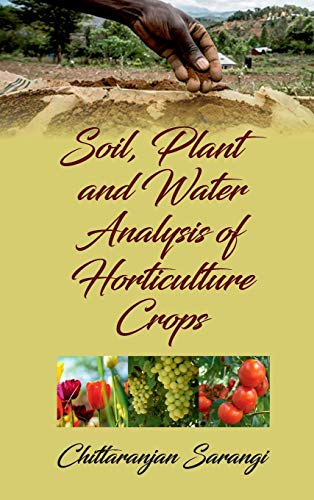
Soil, Plant And Water Analysis Of Horticulture Crops / Chittaranjan Sarangi
Material type: TextLanguage: English Publication details: New Delhi : New India Publishing Agency, 2018.Description: xvi, 99p.: ill.; 25ISBN:
 - 9789386546081
- 23 635 SAR
| Cover image | Item type | Current library | Home library | Collection | Shelving location | Call number | Materials specified | Vol info | URL | Copy number | Status | Notes | Date due | Barcode | Item holds | Item hold queue priority | Course reserves | |
|---|---|---|---|---|---|---|---|---|---|---|---|---|---|---|---|---|---|---|
 General Books
|
CUTN Central Library Medicine, Technology & Management | Non-fiction | 635 SAR (Browse shelf(Opens below)) | Available | 40632 |
1. Introduction 2. Soil Sampling - Importance, Methods of Sampling and Processing of Soil Samples 3. Plant Sampling, Importance, Methods of Sampling and Processing of Plant Samples 4. Hydraulic Conductivity, Darcy’s Law and Termination of Hydraulic Conductivity 5. Renewal of Gases in Soil and Their Abundance 6. Measurement of Oxygen Diffusion Rate (ODR) & Redox Potential 7. Use of Radio Tracer Techniques in Soil Fertility Evaluation & Radio Tracer Technology Application in Plant Nutrient Studies 8. Soil Microorganisms and Their Importance 9. Saline, Alkali, Acid, Waterlogged and Sandy Soils: Their Appraisal and Management 10. Chemical and mineralogical Composition of Important Horticultural Crops 11. Leaf Analysis, Standards and Index Tissues of Different Crops and Interpretation of Leaf Analytical Values 12. Rapid Tissue Tests for Soil and Plant 13. Quality of Irrigation Water 14. Management of Poor Quality Irrigation Water in Crop Management 15. Soil and Water Pollution
Agricultural, horticultural, forestry and fodder production etc. for the burgeoning population are ever increasing enterprises that impose heavy tasks on the management of natural resources. Short term profitability at the cost of sustainability disharmonises the natural forces and processes resulting in peril of the inhabitants of the earth. To this end an understanding with conviction of the principles of soil, plant and water analysis as applied to horticulture will enhance the realization of management goals in harmony with nature. Intended primarily to be a text book, it will help educate learners to follow those principles. Students, planners, faculties and anyone interested in achieving those goals will find it necessarily useful.
There are no comments on this title.