
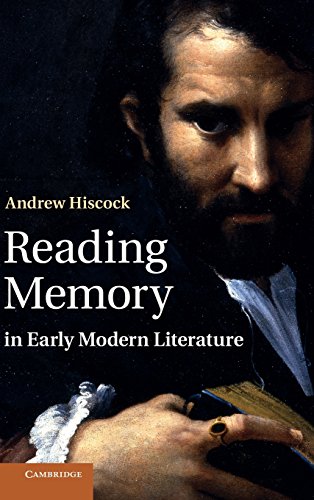
Reading memory in early modern literature / Andrew Hiscock.
Material type: TextPublication details: Cambridge ; New York : Cambridge University Press, 2011.Description: xi, 320 p. : ill. ; 24 cmISBN:
 - 9780521761215 (hardback)
- 0521761212 (hardback)
- PR428.M44 H57 2011
| Cover image | Item type | Current library | Home library | Collection | Shelving location | Call number | Materials specified | Vol info | URL | Copy number | Status | Notes | Date due | Barcode | Item holds | Item hold queue priority | Course reserves | |
|---|---|---|---|---|---|---|---|---|---|---|---|---|---|---|---|---|---|---|
 General Books
|
CUTN Central Library Literature | 820.9358 (Browse shelf(Opens below)) | 1 | Available | 8782 |
Browsing CUTN Central Library shelves,Shelving location: Literature Close shelf browser (Hides shelf browser)

|

|

|

|

|

|
|
||
| 820.9356 RUS Darwinism as religion : | 820.9358 Ireland and postcolonial studies : | 820.9/358 Eighteenth-century British literature and postcolonial studies / | 820.9358 Reading memory in early modern literature / | 820.9358 Literary radicalism in India : | 820.9358 Boys in khaki, girls in print : | 820.9358 Literary radicalism in India : |
Includes bibliographical references and index.
Machine generated contents note: Introduction: 'the dark backward and abyss of time'; 1. 'To seke the place where I my self hadd lost': acts of memory in the poetry of Henry Howard, the Earl of Surrey; 2. 'Remembre not (lorde) myne offences': Katherine Parr and the politics of recollection; 3. 'Better a few things well pondered, than to trouble the memory with too much': troubling memory and martyr in Foxe's Acts and Monuments; 4. Text, recollection and Elizabethan fiction: Gascoigne, Nashe, Deloney; 5. The doleful Clorinda? Mary Sidney, Countess of Pembroke, and the vocation of memory; 6. 'Tell me, where all past yeares are': John Donne and the obligations of memory; 7. 'Of all the powers of the mind [...] the most delicate and fraile': the poetry of Ben Jonson and the renewal of memory; 8. 'This art of memory': Francis Bacon, memory and the discourses of power.
"'He who remembers or recollects, thinks' declared Francis Bacon, drawing attention to the absolute centrality of the question of memory in early modern Britain's cultural life. The vigorous debate surrounding the faculty had dated back to Plato at least. However, responding to the powerful influences of an ever-expanding print culture, humanist scholarship, the veneration for the cultural achievements of antiquity, and sweeping political upheaval and religious schism in Europe, succeeding generations of authors from the reign of Henry VIII to that of James I engaged energetically with the spiritual, political and erotic implications of remembering. Treating the works of a host of different writers from the Earl of Surrey, Katharine Parr and John Foxe, to William Shakespeare, Mary Sidney, Ben Jonson and Francis Bacon, this study explores how the question of memory was intimately linked to the politics of faith, identity and intellectual renewal in Tudor and early Stuart Britain"--
There are no comments on this title.