
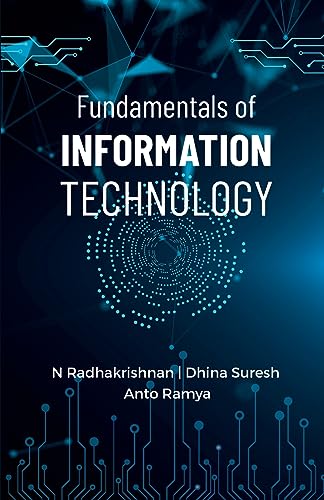
Fundamentals of Information Technology / N. Radhakrishnan, Dhina Suresh, & Anto Ramya
Material type: TextLanguage: English Publication details: India : MJP Publishers , 2023.Description: 210p. : illISBN:
 - 9789355282545
- 004 RAD
| Cover image | Item type | Current library | Home library | Collection | Shelving location | Call number | Materials specified | Vol info | URL | Copy number | Status | Notes | Date due | Barcode | Item holds | Item hold queue priority | Course reserves | |
|---|---|---|---|---|---|---|---|---|---|---|---|---|---|---|---|---|---|---|
 General Books
|
CUTN Central Library Generalia | Non-fiction | 004 RAD (Browse shelf(Opens below)) | Available | 51656 |
Part 1: Introduction to Computers
Chapter 1: Introduction to Information Technology
Definition of IT
Importance and scope of IT
Evolution of computers
Generations of computers
Chapter 2: Computer Basics
What is a computer?
Characteristics of computers
Components of a computer system (hardware, software, data, users)
Types of computers (supercomputers, mainframes, minicomputers, microcomputers)
Part 2: Computer Hardware
Chapter 3: Input Devices
Keyboard, Mouse, Scanner, Microphone, Webcam, etc.
Functionality and types
Chapter 4: Output Devices
Monitors (CRT, LCD, LED), Printers (Inkjet, Laser, Dot Matrix), Speakers, Projectors
Functionality and types
Chapter 5: Central Processing Unit (CPU)
Components of CPU (ALU, Control Unit, Registers)
CPU architecture and performance factors
Chapter 6: Memory
Primary Memory (RAM, ROM)
Secondary Storage (Hard Disk Drive, Solid State Drive, Optical Discs, Flash Drives)
Memory hierarchy
Part 3: Computer Software
Chapter 7: Software Concepts
System Software (Operating Systems, Utility Programs, Device Drivers)
Application Software (General-purpose, Custom-built)
Chapter 8: Operating Systems
Functions of an OS
Types of OS (Windows, macOS, Linux, Android)
Basic OS commands and file management
Chapter 9: Programming Languages
Generations of programming languages (Machine, Assembly, High-level)
Translators (Assemblers, Compilers, Interpreters)
Basic programming concepts
Part 4: Data Communication and Networks
Chapter 10: Data Communication
Data transmission modes
Transmission media (wired, wireless)
Network topologies
Chapter 11: Computer Networks
Types of networks (LAN, WAN, MAN)
Network devices (Hub, Switch, Router, Modem)
Protocols (TCP/IP)
Chapter 12: The Internet and World Wide Web
History of the Internet
Internet services (Email, WWW, FTP)
Web browsers, search engines
E-commerce, online security basics
Part 5: Data Management and Security
Chapter 13: Database Management Systems (DBMS)
Introduction to databases
Types of databases (Relational, Object-oriented)
Basic database concepts
Chapter 14: Information Security
Threats to information systems (Viruses, Malware, Phishing)
Security measures (Firewalls, Antivirus, Encryption)
Cybercrime and ethical issues in IT
An introductory textbook for students to gain a foundational understanding of information technology (IT). It aims to cover the core concepts of IT, including the basics of computers, software, hardware, networking, data management, and the internet. The book likely emphasizes clarity and simplicity in explaining complex technical topics, making it accessible to those new to the field. It provides the essential knowledge required to comprehend how information is processed, stored, and communicated in today's digital world. Given its recent publication, it would also incorporate contemporary aspects of IT.
There are no comments on this title.