
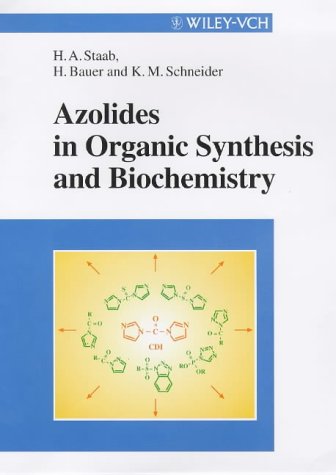
Azolides in organic synthesis and biochemistry
Material type: TextLanguage: Tamil Publication details: Weinheim ; Cambridge : VCH, c1998.Description: x,502p. ; 25cmISBN:
 - 3527293140
- 547.593 STA
| Cover image | Item type | Current library | Home library | Collection | Shelving location | Call number | Materials specified | Vol info | URL | Copy number | Status | Notes | Date due | Barcode | Item holds | Item hold queue priority | Course reserves | |
|---|---|---|---|---|---|---|---|---|---|---|---|---|---|---|---|---|---|---|
 Text Books
|
CUTN Central Library Sciences | Non-fiction | 547.593 STA (Browse shelf(Opens below)) | Available | 42988 |
In the late fifties and early sixties H. A. Staab discovered N,N′-carbonyl-diimidazole (CDI), its analogues, and the family of azolides derived from them. Soon these compounds became widely appreciated as synthetic building blocks of unsurpassed diversity. The spectrum of substances, that can be obtained via mild acylation with azolides includes esters, amides, ketones, aldehydes, as well as heterocycles, peptides, glycosides, and nucleotides.
Now, H. A. Staab, the ′father′ of these useful compounds, together with his coauthors H. Bauer and K. M. Schneider, has gathered their preparation, properties, and manifold applications in a comprehensive and topical overview.
Are you in the field of synthesis of natural products, biomolecules, heterocycles, or other complicated organic compounds? Then, your first glance might well be into ′Staab′- this handbook should always be within reach of your desk or lab bench.
There are no comments on this title.