
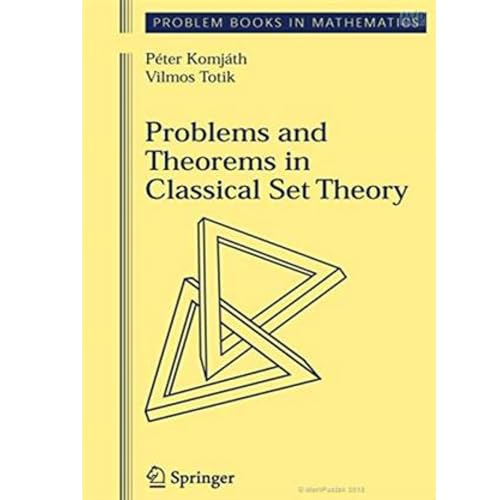
Problems and Theorems in Classical Set Theory /
Material type: TextLanguage: English Publication details: Springer, 2006.Description: 516p.: illISBN:
 - 9781071603710
- 511.322 KOM
| Cover image | Item type | Current library | Home library | Collection | Shelving location | Call number | Materials specified | Vol info | URL | Copy number | Status | Notes | Date due | Barcode | Item holds | Item hold queue priority | Course reserves | |
|---|---|---|---|---|---|---|---|---|---|---|---|---|---|---|---|---|---|---|
 Project book
|
CUTN Central Library | Non-fiction | 511.322 KOM (Browse shelf(Opens below)) | Checked out to Renuka Devi V (20019T) | 21/02/2025 | 51937 |
Front Matter
Pages 1-1
Operations on sets
Pages 3-7
Countability
Pages 9-12
Equivalence
Pages 13-14
Continuum
Pages 15-18
Sets of reals and real functions
Pages 19-21
Ordered sets
Pages 23-31
Order types
Pages 33-36
Ordinals
Pages 37-41
Ordinal arithmetic
Pages 43-50
Cardinals
Pages 51-54
Partially ordered sets
Pages 55-57
Transfinite enumeration
Pages 59-61
Euclidean spaces
Pages 63-64
Zorn’s lemma
Pages 65-66
Hamel bases
Pages 67-69
The continuum hypothesis
Pages 71-73
Ultrafilters on ω
Pages 75-78
Families of sets
Pages 79-80
The Banach-Tarski paradox
Pages 81-83
Stationary sets in ω1
Pages 85-87
Stationary sets in larger cardinals
Pages 89-92
Canonical functions
Pages 93-94
Infinite graphs
Pages 95-99
Partition relations
Pages 101-105
Δ-systems
Pages 107-108
Set mappings
Pages 109-110
Trees
Pages 111-115
The measure problem
Pages 117-121
Stationary sets in [λ]<κ
Pages 123-125
The axiom of choice
Pages 127-128
Well-founded sets and the axiom of foundation
Pages 129-132
Solutions
Front Matter
Pages 133-133
Operations on sets
Pages 135-146
Countability
Pages 147-157
Equivalence
Pages 159-162
Continuum
Pages 163-172
Sets of reals and real functions
Pages 173-183
Ordered sets
Pages 185-212
Order types
Pages 213-222
Ordinals
Pages 223-235
Ordinal arithmetic
Pages 237-263
Cardinals
Pages 265-273
Partially ordered sets
Pages 275-284
Transfinite enumeration
Pages 285-297
Euclidean spaces
Pages 299-307
Zorn’s lemma
Pages 309-316
Hamel bases
Pages 317-326
The continuum hypothesis
Pages 327-339
Ultrafilters on ω
Pages 341-349
Families of sets
Pages 351-357
The Banach-Tarski paradox
Pages 359-368
Stationary sets in ω1
Pages 369-376
Stationary sets in larger cardinals
Pages 377-383
Canonical functions
Pages 385-387
Infinite graphs
Pages 389-403
Partition relations
Pages 405-420
Δ-systems
Pages 421-425
Set mappings
Pages 427-432
Trees
Pages 433-451
The measure problem
Pages 453-462
Stationary sets in [λ]<κ
Pages 463-470
The axiom of choice
Pages 471-479
Well-founded sets and the axiom of foundation
Pages 481-489
Back Matter
Pages 491-516
Although the ?rst decades of the 20th century saw some strong debates on set theory and the foundation of mathematics, afterwards set theory has turned into a solid branch of mathematics, indeed, so solid, that it serves as the foundation of the whole building of mathematics. Later generations, honest to Hilbert’s dictum, “No one can chase us out of the paradise that Cantor has created for us” proved countless deep and interesting theorems and also applied the methods of set theory to various problems in algebra, topology, in?nitary combinatorics, and real analysis. The invention of forcing produced a powerful, technically sophisticated tool for solving unsolvable problems. Still, most results of the pre-Cohen era can be digested with just the knowledge of a commonsense introduction to the topic. And it is a worthy e?ort, here we refer not just to usefulness, but, ?rst and foremost, to mathematical beauty. In this volume we o?er a collection of various problems in set theory. Most of classical set theory is covered, classical in the sense that independence methods are not used, but classical also in the sense that most results come fromtheperiod,say,1920–1970.Manyproblemsarealsorelatedtoother?elds of mathematics such as algebra, combinatorics, topology, and real analysis. We do not concentrate on the axiomatic framework, although some - pects, such as the axiom of foundation or the role ˆ of the axiom of choice, are elaborated.
There are no comments on this title.