
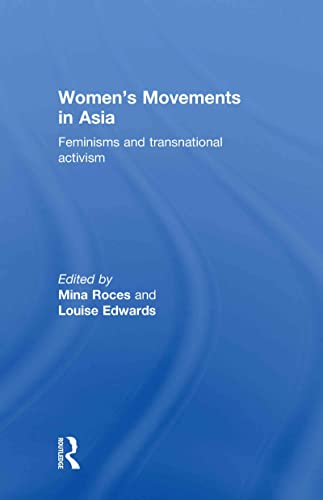
Women's movements in Asia : feminisms and transnational activism / edited by Mina Roces and Louise Edwards.
Material type: TextLanguage: English Publication details: Milton Park, Abingdon, Oxon ; New York, NY : Routledge, 2010.Description: x, 276 p. ; 24 cmISBN:
 - 9780415487023 (hbk.)
- 0415487021 (hbk.)
- 9780415487030 (pbk.)
- 041548703X (pbk.)
- 9780203851234 (ebk.)
- 9781032032542
- 305.420 22 ROC
| Cover image | Item type | Current library | Home library | Collection | Shelving location | Call number | Materials specified | Vol info | URL | Copy number | Status | Notes | Date due | Barcode | Item holds | Item hold queue priority | Course reserves | |
|---|---|---|---|---|---|---|---|---|---|---|---|---|---|---|---|---|---|---|
 General Books
|
CUTN Central Library Social Sciences | Non-fiction | 305.420 ROC (Browse shelf(Opens below)) | Available | 49384 |
Includes bibliographical references and index.
Contents
Acknowledgements
Contributors
1 Asian feminisms
The ‘F’ word and the ‘T’ word
Women’s issues from an Asian perspective
Political contexts
Transnational secular and religious worlds
Track records
Note
References
2 Feminism and the women’s movement in the world’s largest Islamic nation
What is similar to elsewhere in Asia
What is particular about Indonesia?
Conclusion
Notes
References
3 Rethinking ‘the Filipino woman’
A brief history of women’s movements in the Philippines
Theorizing ‘the Filipina’
Criticizing grand narratives and fashioning new ones
Locating women
Practices: fashioning women
Looking back, looking forward, looking outwards
Notes
References
4 Chinese feminism in a transnational frame
Pendulum swings in international engagement
Building a feminist movement with global partners prior to 1949
Managing state feminism and isolationist nationalism
Engaging with the world but hampered by nationalism, 1979–2009
Conclusion
Notes
References
5 Transnational networks and localized campaigns
Activism in the colonial period
The struggle against polygamy
The Great Marriage Debate
The rights of foreign workers
Achievements and setbacks
One organization movement?
Conclusion
Notes
References
6 Crossing boundaries
The state, transnationalism and feminism in Japanese historiography
Transnational influences and modernity
Transnational feminism and Christianity
Transnationalism and secular feminists’ quest for political inclusion
Postscript
References
7 Feminism, Buddhism and transnational women’s movements in Thailand
Thai gender orders
Women’s movements
Prostitution and Thai sex workers
The transnational bhikkhuni movement
Conclusion
Note
References
8 Following the trail of the fairy-bird
The origin of the myth
The political and legal status of women in dynastic Vietnam
The colonial period
Feminism’s marriage with socialism
Challenges for the women’s movement after (Renovation)
Conclusion
Notes
References
9 The Hong Kong women’s movement
The Hong Kong women’s movement in the colonial period
Divisions within the Hong Kong women’s movement in the lead-up to 1997
Political opportunities and social networks
Strategies and symbolic politics
Conclusion
Notes
References
10 Military rule, religious fundamentalism, women’s empowerment and feminism in Pakistan
Marking the terrain
A movement in the making
Keeping up the momentum
Tomorrow’s agenda—achievements, failures and challenges ahead
Notes
References
11 Mapping a hundred years of activism
Beginnings
Colonial period (1910–45)
Liberation to the fall of Syngman Rhee
Women’s movements under military dictatorship (1961–86)
Gradual transition to democracy and the role of women’s movements (1987–97)
Women-friendly governments and the institutionalization of women’s movements (1998–2007)
Neo-Conservative retreat
Conclusion
Notes
References
12 ‘Riding a buffalo to cross a muddy field’
Cambodian ‘feminism’ negotiating the space between colonialism and nationalism
Marshalling notions of ‘tradition’
Feminism in post-colonial Cambodia
Tradition redux
Contemporary constructions of feminism
Notes
References
13 Rights talk and the feminist movement in India
Rights worries and feminist politics
Progressive legalism,3 rights and gender
Developing women
Empowering women
Conclusion
Notes
References
Index
Women's Movements in Asia is a comprehensive study of women’s activism across Asia. With chapters written by leading international experts, it provides a full overview of the history of feminism, as well as the current context of the women’s movement in 12 countries: the Philippines, China, Indonesia, Japan, Burma, Singapore, Vietnam, Malaysia, Thailand, Cambodia, Hong Kong, Korea, India and Pakistan. For each of these countries the manner in which feminism changes according to cultural, political, economic and religious factors is explored. The contributors investigate how national feminisms are influenced by transnational factors, such as the women’s movements in other countries, colonialism and international agencies. Each chapter also considers what Asian feminists have contributed to global theoretical debates on the woman question, the key successes and failures of the movements and what needs to be addressed in the future. This breadth of coverage, together with suggestions for further reading and watching, and an integrated cross-national timeline makes Women's Movements in Asia ideal for use on courses looking at women and feminism in Asia. It will appeal both to students and specialists in the fields of gender, women’s and Asian studies.
There are no comments on this title.