
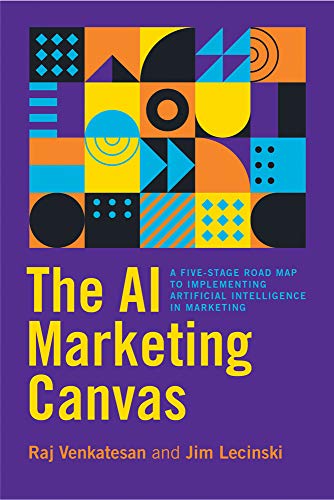
The AI Marketing Canvas : A Five-Stage Road Map to Implementing Artificial Intelligence in Marketing / Raj Venkatesan, Jim Lecinski.
Material type: TextLanguage: Publisher: Stanford, CA Stanford University Press, [2021]Copyright date: ©2021Description: 1 online resource (272 p.)Content type:
 - text
- computer
- online resource
- 9781503628045
- POLITICAL SCIENCE / Public Policy / Economic Policy
- BUSINESS & ECONOMICS / Marketing / General
- BUSINESS & ECONOMICS / Management
- marketing
- marketing strategy
- digital marketing
- online marketing
- artificial intelligence
- machine learning
- AI
- AI strategy
- AI for marketing
- one-to-one marketing
- marketing
- marketing strategy
- digital marketing
- online marketing
- artificial intelligence
- machine learning
- AI
- AI strategy
- AI for marketing
- one-to-one marketing
| Cover image | Item type | Current library | Home library | Collection | Shelving location | Call number | Materials specified | Vol info | URL | Copy number | Status | Notes | Date due | Barcode | Item holds | Item hold queue priority | Course reserves | |
|---|---|---|---|---|---|---|---|---|---|---|---|---|---|---|---|---|---|---|
| Electronic Books | CUTN Central Library | Link to resource | Available | EB04754 |
Frontmatter -- Contents -- Notice to Readers -- Figures -- PART 1. The Challenge and the Solution -- PART 2. AI and Marketing Essentials -- PART 3. The AI Marketing Canvas -- PART 4. Implementation -- Acknowledgments -- Notes -- Index -- About the Authors
restricted access online access with authorization star
http://purl.org/coar/access_right/c_16ec
This book offers a direct, actionable plan CMOs can use to map out initiatives that are properly sequenced and designed for success-regardless of where their marketing organization is in the process. The authors pose the following critical questions to marketers: (1) How should modern marketers be thinking about artificial intelligence and machine learning? and (2) How should marketers be developing a strategy and plan to implement AI into their marketing toolkit? The opening chapters provide marketing leaders with an overview of what exactly AI is and how is it different than traditional computer science approaches. Venkatesan and Lecinski, then, propose a best-practice, five-stage framework for implementing what they term the "AI Marketing Canvas." Their approach is based on research and interviews they conducted with leading marketers, and offers many tangible examples of what brands are doing at each stage of the AI Marketing Canvas. By way of guidance, Venkatesan and Lecinski provide examples of brands-including Google, Lyft, Ancestry.com, and Coca-Cola-that have successfully woven AI into their marketing strategies. The book concludes with a discussion of important implications for marketing leaders-for your team and culture.
Mode of access: Internet via World Wide Web.
Raj Venkatesan is the Ronald Trzcinski Professor of Business Administration in the Darden Graduate School of Business Administration at the University of Virginia. His writing has appeared in the Journal of Marketing and Harvard Business Review, among others, and he is the coauthor of Marketing Analytics (2021). Jim Lecinski is a Clinical Associate Professor of Marketing at Northwestern University's Kellogg School of Management. His thirty years of experience as a marketing adviser for prominent global brands includes a twelve-year stint at Google, where he was vice president of customer solutions. He is the author of Winning the Zero Moment of Truth (2011).
In English.
Description based on online resource; title from PDF title page (publisher's Web site, viewed March 03 2026)
There are no comments on this title.