
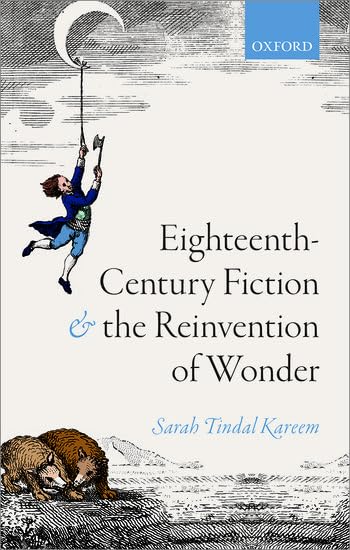
Eighteenth-century fiction and the reinvention of wonder / Sarah Tindal Kareem.
Material type: TextEdition: First editionDescription: xiv, 278 pages : illustrations ; 23 cmISBN:
 - 9780199689101 (hbk.)
- 0199689105 (hbk.)
- 18th-century fiction and the reinvention of wonder
- 810 KAR
| Cover image | Item type | Current library | Home library | Collection | Shelving location | Call number | Materials specified | Vol info | URL | Copy number | Status | Notes | Date due | Barcode | Item holds | Item hold queue priority | Course reserves | |
|---|---|---|---|---|---|---|---|---|---|---|---|---|---|---|---|---|---|---|
 Text Books
|
CUTN Central Library Literature | Fiction | 810 KAR (Browse shelf(Opens below)) | Available | 26439 |
Includes bibliographical references (pages 229-258) and index.
Introduction: Wonder and the rise of fiction -- Wonder in the age of enlightenment -- Rethinking the real with Robinson Crusoe and David Hume -- Suspending the reader in Tom Jones and The Castle of Otranto -- "Marvelous tales of wonders performed, or rather, not performed" in Baron Munchausen's Narrative -- "A little voyage of discovery?": fiction and the pursuit of knowledge -- Epilogue.
A footprint materializes mysteriously on a deserted shore; a giant helmet falls from the sky; a traveler awakens to find his horse dangling from a church steeple. Eighteenth-century fiction brims with moments such as these, in which the prosaic rubs up against the marvelous. While it is a truism that the period's literature is distinguished by its realism and air of probability, Eighteenth-Century Fiction and the Reinvention of Wonder argues that wonder is integral to-rather than antithetical to-the developing techniques of novelistic fiction. Positioning its reader on the cusp between recognition and estrangement, between faith and doubt, modern fiction hinges upon wonder. 'Eighteenth-Century Fiction and the Reinvention of Wonder's chapters unfold its new account of fiction's rise through surprising new readings of classic early novels-from Daniel Defoe's Robinson Crusoe to Jane Austen's Northanger Abbey-as well as bringing to attention lesser known works, most notably Rudolf Raspe's Baron Munchausen's 'Narrative of His Marvellous Travels'. In this bold new account, the eighteenth century bears witness not to the world's disenchantment but rather to wonder's re-location from the supernatural realm to the empirical world, providing a re-evaluation not only of how we look back at the Enlightenment, but also of how we read today.
There are no comments on this title.