
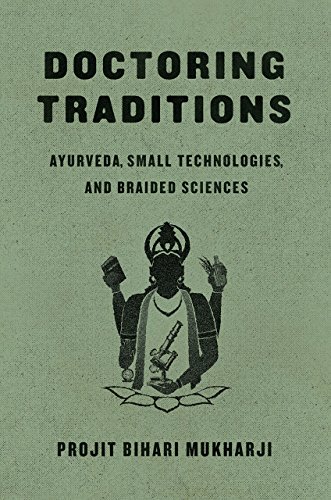
Doctoring Traditions : Ayurveda, Small Technologies, and Braided Sciences/ Projit Bihari Mukharji.
Material type: TextLanguage: English Publication details: London : The University of Chicaco Press, 2016.Description: 374 p. : Ill, ; 6x9ISBN:
 - 9780226383132
- 23 615.538 MUK
| Cover image | Item type | Current library | Home library | Collection | Shelving location | Call number | Materials specified | Vol info | URL | Copy number | Status | Notes | Date due | Barcode | Item holds | Item hold queue priority | Course reserves | |
|---|---|---|---|---|---|---|---|---|---|---|---|---|---|---|---|---|---|---|
 Project book
|
CUTN Central Library Medicine, Technology & Management | Non-fiction | 615.538 MUK (Browse shelf(Opens below)) | Checked out to Kanagarathinam DV (23001T) | Project for Department of History (Book transferred to concern project faculty) ICHR Project | 01/06/2026 | 52108 |
Table of Contents Prefatory Notes
Introduction: Braiding Knowledge: Refiguring Ayurveda
Chapter One: A Baidya-Bourgeois World: The Sociology of Braided Sciences
Chapter Two: The Clockwork Body: The Pocket Watch and Machinic Physiospiritualism
Chapter Three: The Snayubik Man: Reticulate Physiospiritualism and the Thermometer
Chapter Four: The Chiaroscuric Man: Visionaries, Demonic Germs, and the Microscope
Chapter Five: Endocrino-Chakric Machine: Hormonized Humors and Organotherapy
Chapter Six: Baidya-as-Technology: From Diagnosis to Pharmacy in a Bottle
Conclusion: The Pataphysics of Cosmo-Therapeutics: A Requiem
Acknowledgments
Bibliography
Index
Like many of the traditional medicines of South Asia, Ayurvedic practice transformed dramatically in the later nineteenth and early twentieth centuries. With Doctoring Tradition, Projit Bihari Mukharji offers a close look at that recasting, upending the widely held yet little-examined belief that it was the result of the introduction of Western anatomical knowledge and cadaveric dissection.
Rather, Mukharji reveals, what instigated those changes were a number of small technologies that were introduced in the period by Ayurvedic physicians, men who were simultaneously Victorian gentlemen and members of a particular Bengali caste. The introduction of these devices, including thermometers, watches, and microscopes, Mukharji shows, ultimately led to a dramatic reimagining of the body. By the 1930s, there emerged a new Ayurvedic body that was marked as distinct from a biomedical body. Despite the protestations of difference, this new Ayurvedic body was largely compatible with it. The more irreconcilable elements of the old Ayurvedic body were then rendered therapeutically indefensible and impossible to imagine in practice. The new Ayurvedic medicine was the product not of an embrace of Western approaches, but of a creative attempt to develop a viable alternative to the Western tradition by braiding together elements drawn from internally diverse traditions of the West and the East.
There are no comments on this title.