
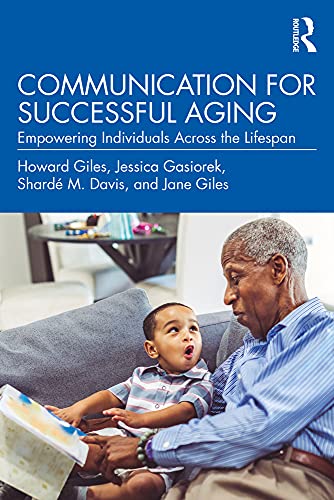
Communication for successful aging : empowering individuals across the lifespan / Howard Giles, Jessica Gasiorek, Shardé M. Davis, & Jane Giles.
Material type: TextLanguage: English Publication details: New York, NY : Routledge, 2022.Description: xiii, 149 pages : illustrations (some color)ISBN:
 - 9780429330681
- 0429330685
- 9781000476040
- 1000476049
- 9781000476057
- 1000476057
- 155.671 23 GIL
| Cover image | Item type | Current library | Home library | Collection | Shelving location | Call number | Materials specified | Vol info | URL | Copy number | Status | Notes | Date due | Barcode | Item holds | Item hold queue priority | Course reserves | |
|---|---|---|---|---|---|---|---|---|---|---|---|---|---|---|---|---|---|---|
 Project book
|
CUTN Central Library | Non-fiction | 155.671 GIL (Browse shelf(Opens below)) | Checked out to Boobala Krishnan (17053A) | 29/12/2025 | 55522 |
Matters of communication and aging -- Messages of agism and age stereotypes -- Age identities: what are they and how do they emerge? -- The ingredients of intergenerational communication -- The media, agism, and anti-aging -- Talking about death -- or not -- Successful aging and communication -- Conclusions and vistas: communicating resilience, hope, and empowerment.
Access restricted to subscribing institutions.
"This essential volume explores the vital role of communication in the aging process and how this varies for different social groups and cultural communities. It reveals how communication can empower people in the process of aging, and that how we communicate about age is critically important to - and is at the heart of - aging successfully. Giles et al. confront the uncertainty and negativity surrounding "aging" - a process with which we all have to cope - by expertly placing communication at the core of the process. They address the need to avoid negative language, discuss the lifespan as an evolving adventure, and introduce a new theory of successful aging: The communication ecology model of successful aging (CEMSA). They explore the research on key topics including: Age stereotypes; age identities, and messages of ageism; the role of culture, gender, ethnicity, and being a member of marginalized groups; the ingredients of intergenerational communication; depiction of aging and youth in the media; and how and why talk about death and dying can be instrumental in promoting control over life's demands. Communication for Successful Aging is essential reading for graduate students of psychology, human development, gerontology, communication, as well as scholars in the social sciences, and all of us concerned with this complex academic topic, and personal challenge"--
There are no comments on this title.