
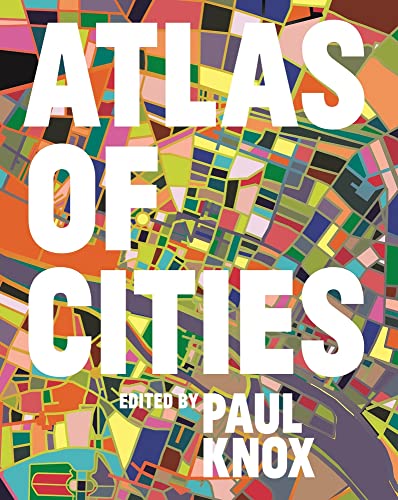
Atlas of Cities Richard Florida, Richard Florida, Paul Knox.
Material type: TextLanguage: Publisher: Princeton, NJ Princeton University Press, [2022]Copyright date: ©2022Description: 1 online resourceContent type:
 - text
- computer
- online resource
- 9781400851942
- BUSINESS & ECONOMICS / Industries / Transportation
- TECHNOLOGY & ENGINEERING / Cartography
- SOCIAL SCIENCE / Sociology / Urban
- POLITICAL SCIENCE / General
- Global city
- Infrastructure
- Mumbai
- Technology
- Urbanization
- Megacity
- Slum
- City-state
- Bruges
- Wealth
- Globalization
- Roman Law
- Hinterland
- Beijing
- Green economy
- Constantinople
- Public transport
- Industrialisation
- Urban sprawl
- Mexico City
- Urban renewal
- Urban planning
- Tourism
- Entrepreneurship
- Latin America
- Retail
- China
- Urban agglomeration
- Economic development
- Gentrification
- Byzantium
- Bangkok
- Dharavi
- Suburb
- Commercial Revolution
- Guangzhou
- Living lab
- Rue de Rivoli
- New York City
- Federal District (Brazil)
- Greenhouse gas
- Machiavellianism
- Ethnic enclave
- Sulla
- Ottoman Empire
- Central business district
- Metropolitan area
- Colonial exhibition
- Creative Cities Network
- Economic growth
- Suburbanization
- Real estate bubble
- CityLife (Milan)
- Masdar City
- Urban hierarchy
- Overcrowding
- Roman Empire
- Middle Ages
- Congestion pricing
- Main City
- Declamation
- Overurbanization
- Sustainable city
- Conurbation
- Hellenistic period
- Champagne fairs
- Haussmann's renovation of Paris
- Manufacturing
- Governance
- Civilization
- Global city
- Infrastructure
- Mumbai
- Technology
- Urbanization
- Megacity
- Slum
- City-state
- Bruges
- Wealth
- Globalization
- Roman Law
- Hinterland
- Beijing
- Green economy
- Constantinople
- Public transport
- Industrialisation
- Urban sprawl
- Mexico City
- Urban renewal
- Urban planning
- Tourism
- Entrepreneurship
- Latin America
- Retail
- China
- Urban agglomeration
- Economic development
- Gentrification
- Byzantium
- Bangkok
- Dharavi
- Suburb
- Commercial Revolution
- Guangzhou
- Living lab
- Rue de Rivoli
- New York City
- Federal District (Brazil)
- Greenhouse gas
- Machiavellianism
- Ethnic enclave
- Sulla
- Ottoman Empire
- Central business district
- Metropolitan area
- Colonial exhibition
- Creative Cities Network
- Economic growth
- Suburbanization
- Real estate bubble
- CityLife (Milan)
- Masdar City
- Urban hierarchy
- Overcrowding
- Roman Empire
- Middle Ages
- Congestion pricing
- Main City
- Declamation
- Overurbanization
- Sustainable city
- Conurbation
- Hellenistic period
- Champagne fairs
- Haussmann's renovation of Paris
- Manufacturing
- Governance
- Civilization
| Cover image | Item type | Current library | Home library | Collection | Shelving location | Call number | Materials specified | Vol info | URL | Copy number | Status | Notes | Date due | Barcode | Item holds | Item hold queue priority | Course reserves | |
|---|---|---|---|---|---|---|---|---|---|---|---|---|---|---|---|---|---|---|
| Electronic Books | CUTN Central Library | Link to resource | Available | EB04688 |
Frontmatter -- Dedication -- Contents -- Foreword / Richard Florida -- Introduction / Paul Knox -- The Foundational City / Lila Leontidou, Guido Martinotti -- The Networked City / Raf Verbruggen, Michael Hoyler, Peter Taylor -- The Imperial City / Asli Ceylan Oner -- The Industrial City / Jane Clossick -- The Rational City / Andrew Herod -- The Global City / Ben Derudder, Peter Taylor, Michael Hoyler, Frank Witlox -- The Celebrity City / Elizabeth Currid-Halkett -- The Megacity / Jan Nijman, Michael Shin -- The Instant City / Lucia Cony-Cidade -- The Transitional City / Jan Nijman, Michael Shin -- The Creative City / Paul Knox -- The Green City / Heike Mayer -- The Intelligent City / Kevin C. Desouza -- Glossary -- Resources -- Contributors -- Index -- Acknowledgments
restricted access online access with authorization star
http://purl.org/coar/access_right/c_16ec
A unique, stunningly illustrated look at the origins, development, and future prospects of citiesMore than half the world's population lives in cities, and that proportion is expected to rise to three-quarters by 2050. Urbanization is a global phenomenon, but the way cities are developing, the experience of city life, and the prospects for the future of cities vary widely from region to region. The Atlas of Cities presents a unique taxonomy of cities that looks at different aspects of their physical, economic, social, and political structures; their interactions with each other and with their hinterlands; the challenges and opportunities they present; and where cities might be going in the future.Each chapter explores a particular type of city-from the foundational cities of Greece and Rome and the networked cities of the Hanseatic League, through the nineteenth-century modernization of Paris and the industrialization of Manchester, to the green and "smart" cities of today. Expert contributors explore how the development of these cities reflects one or more of the common themes of urban development: the mobilizing function (transport, communication, and infrastructure); the generative function (innovation and technology); the decision-making capacity (governance, economics, and institutions); and the transformative capacity (society, lifestyle, and culture).Using stunning info-graphics, maps, charts, tables, and photographs, the Atlas of Cities is a comprehensive overview of the patterns of production, consumption, generation, and decay of the twenty-first century's defining form.Presents a one-of-a-kind taxonomy of cities that looks at their origins, development, and future prospectsFeatures core case studies of particular types of cities, from the foundational cities of Greece and Rome to the "smart" cities of todayExplores common themes of urban development, from transport and communication to lifestyle and cultureIncludes stunning info-graphics, maps, charts, tables, and photosCities Featured:Abuja, Alexandria, Amsterdam, Athens, Augsburg, Babylon, Beijing, Berlin, Brasilia, Bruges, Budapest, Cairo, Canberra, Chandigarh, Chicago, Constantinople, Curitiba, Detroit, Dubai, Dublin, Düsseldorf, Florence, Frankfurt, Freiburg, Geneva, Ghent, Glasgow, Güssing, Hong Kong, Innsbruck, Istanbul, Jakarta, Karachi, Knossos, Las Vegas, London, Los Angeles, Lübeck, Manchester, Marseille, Masdar City, Mexico City, Miami, Milan, Mumba, Mumbai, Nairobi, New York, Paris, Pella, Portland, Rome, San Francisco, Santorini, São Paulo, Seoul, Shanghai, Sheffield, Singapore, Sparta, St. Petersburg, Stockholm, Sydney, Syracuse, Tokyo, Vancouver, Venice, Vienna, Washington, D.C., Wildpoldsried
Mode of access: Internet via World Wide Web.
Paul Knox is University Distinguished Professor of Urban Affairs and Planning and codirector of the Global Forum on Urban and Regional Resilience at Virginia Polytechnic Institute and State University. His many books include Palimpsests: Biographies of 50 City Districts, Cities and Design, and Urban Social Geography.
In English.
Description based on online resource; title from PDF title page (publisher's Web site, viewed March 03 2026)
There are no comments on this title.