
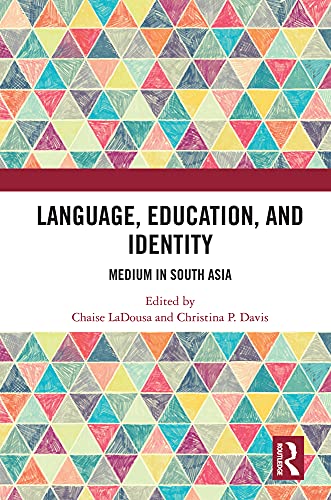
Language, education, and identity : medium in South Asia / edited by Chaise LaDousa and Christina P. Davis.
Material type: TextLanguage: English Publication details: Routledge, 2022.ISBN:
 - 9781003146278
- 379.260 23 LAD
| Cover image | Item type | Current library | Home library | Collection | Shelving location | Call number | Materials specified | Vol info | URL | Copy number | Status | Notes | Date due | Barcode | Item holds | Item hold queue priority | Course reserves | |
|---|---|---|---|---|---|---|---|---|---|---|---|---|---|---|---|---|---|---|
 General Books
|
CUTN Central Library Social Sciences | Non-fiction | 379.260 LAD (Browse shelf(Opens below)) | Available | 49336 |
Browsing CUTN Central Library shelves,Shelving location: Social Sciences,Collection: Non-fiction Close shelf browser (Hides shelf browser)

|

|

|

|

|

|

|
||
| 379.17 MAC Education during adolescence; based partly on G. Stanley Hall's psychology of adolescence: | 379.2409 HER Patrons of women : | 379.26 COL Education, Equality and Human Rights : | 379.260 LAD Language, education, and identity : medium in South Asia / | 379.26 PER Equity warriors : creating schools that students deserve / | 379.260954 MAT The right to education in India : | 379.54 BHA Handbook of national education policy 2020, Vol. 1 / |
Includes bibliographical references and index.
Cover
Half Title
Title
Copyright
Contents
Notes on contributors
Acknowledgments
List of abbreviations
1 Medium in South Asia: ethnography, discourse, and policy
Part I The meanings of medium
2 Medium and coaching centers in North India
3 Medium discourses and the construction of self and other in social media in postcolonial Bangladesh
4 Media of medium: language boundaries and multimodal semiotic ecologies in Nepali schools for deaf students
Part II Medium, identity, and the production of inequality
5 Romance, Austen, and English-medium schooling in Pakistan
6 Muslims in Sri Lankan language politics: Tamil- and English-medium education
7 Labor migration and English-medium schooling in Nepal
8 English-medium education and patriarchy: narratives of Indian women
9 Recognizing diversity: multiethnic Sinhala- and Tamil-medium schools in Sri Lanka
Part III Medium and considerations of policy
10 The Right to Education Act: medium and dis-citizenship
Index
"This book examines medium of instruction in education and studies its social, economic, and political significance in the lives of people living in South Asia. It provides insight into the meaning of medium and what makes it so important to identity, aspiration, and inequality. It questions the ideologized associations between education and social and spatial mobility and discusses the gender- and class-based marginalization that comes with vernacular-medium education. The volume also considers how policy measures, such as the Right to Education (RTE) Act in India, have failed to address the inequalities brought by medium in schools, and investigates questions on language access, inclusion, and rights. Drawing on extensive fieldwork and in-depth interviews, the book will be indispensable for students and scholars of anthropology, education studies, sociolinguistics, sociology, and South Asian studies. It will also appeal to those interested in language and education in South Asia, especially the role of language in the reproduction of inequality"--
There are no comments on this title.