
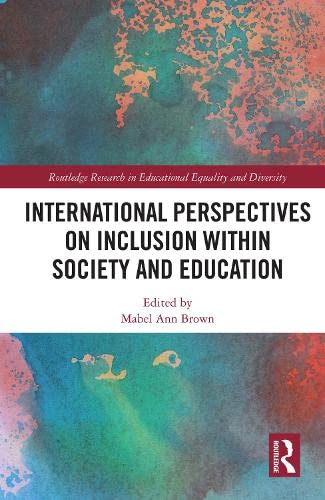
International perspectives on inclusion within society and education / edited by Mabel Ann Brown.
Material type: TextLanguage: English Series: Publication details: Routledge, 2021.Description: xviii, 176 pages illustrations (black and white) ; 24 cmISBN:
 - 9781000201840
- 1000201848
- 9781000201864
- 1000201864
- 9781003016090
- 100301609X
- 371 BRO
| Cover image | Item type | Current library | Home library | Collection | Shelving location | Call number | Materials specified | Vol info | URL | Copy number | Status | Notes | Date due | Barcode | Item holds | Item hold queue priority | Course reserves | |
|---|---|---|---|---|---|---|---|---|---|---|---|---|---|---|---|---|---|---|
 General Books
|
CUTN Central Library Social Sciences | Non-fiction | 371 BRO (Browse shelf(Opens below)) | Available | 50275 |
Part One International inclusion or exclusion: Inclusion in society, dual citizenship, political loyalty and migration Inclusion in Society and Education – An IntroductionMabel Ann Brown Migration- a defining issue of the 21st centuryNicola Scarrott Inclusion and the European Union Mabel Ann Brown Upskill America? The implications of neoliberal discourses in educational programs for migrant learners Johanna Ennser Kananen and Jen Vanek Finnish-Russian dual citizens and the changing political climate of supranational citizenship Jussi Ronkainen and Marko Kananen Kosovar Albanians in Greece: could education promote reconciliation and social inclusion in the wider Region?Mary Drosopulos Part Two Poverty, educational disadvantage and inclusion: Youth radicalization, vulnerability, disadvantage and inequality ‘This is our tradition’: conservatism and exclusion at the roots of radicalization; the case of the Kosovar Albanian diaspora in Switzerland Mary Drosopulos Educational exclusions and practices of Inclusion from urban disadvantaged neighbourhoods Anita Gulczynska and Monika Wiśniewska-Kin The inclusion of children living in substandard forms of housing in the Czech Republic: in the context of involuntary residential mobility Alice Gojova and Soňa Vávrová Part Three Education and Inclusion: Education for all, cohesive society, oppression, disability, disadvantage Inclusive education as the turning point for the dignified life course of children with disabilities Jonas Ruskus How it feels to be jeered at: perceptions of inclusion/ exclusionMara Dirba Inclusive Dimensions of Higher Education in IndiaHilaria Soundari and Thomas Amirtham Is there a clear effect? The role of the school managing social exclusion in HungaryLajos Hüse, Mihály Fónai, Viktória Pázmány, Erika Zolnai and Nóra Barnucz Conclusion Mabel Ann Brown
Online version restricted to NUS staff and students only through NUSNET.
International Perspectives on Inclusion within Society and Education explores how the theme of inclusion in education and society plays out across different nations and cultures. Covering topics like dual citizenship, political loyalty, and migration, it includes important discussions around poverty, educational disadvantage, youth radicalisation and inequality. With perspectives from a wide range of countries, including the USA, UK, Finland, Kosovo, Albania, Poland, Lithuania, Latvia, Hungary, the Czech Republic, Slovakiaand India, this book explores how issues of inclusion are often decided by a majority for the majority, which can lead to included minorities feeling disadvantaged and paradoxically excluded. While setting up a strong case for inclusion in society and education, it considers factors such as poverty and mental health both nationally and internationally and evaluates the effectiveness of additional financial resources and educational support in creating an inclusive world. This book will be of great interest for academics, researchers, and post graduate students in the fields of comparative education, inclusive education, sociology, political sciences and social work.
Mode of access: World Wide Web.
System requirements: Internet connectivity; World Wide Web browser.
There are no comments on this title.